 By Caleb Morgan
Updated November 2026
Brown rubber landscape edging is a popular choice for separating lawn from mulch, gravel or garden beds without the look of heavy masonry. Most buyers want a border that stays straight, holds its color, installs without a trench or concrete, and works with the length of run they actually have. The six products below were compared on manufacturer specifications, brand reputation and the patterns owners tend to mention in feedback, including height, length per pack, stake count and flexibility. None of them were installed or tested for this article.
Our top picks at a glance
- 1
 TOP CHOICEBest overallL No-Dig Rubber Landscape Edging with Hardware, 3.125" x 8', BrownView on Amazon
- 2
 TOP CHOICEBest for curved beds4' Rubber Cobblestone Flexible No Dig Landscape Mulch Border Edging with Anchoring SpikesView on Amazon
- 3
 TOP CHOICEBest for decorative bordersSmart-Loc Rubber 4-Foot Scalloped Landscape Edging Border (12, Brown)View on Amazon
- 4
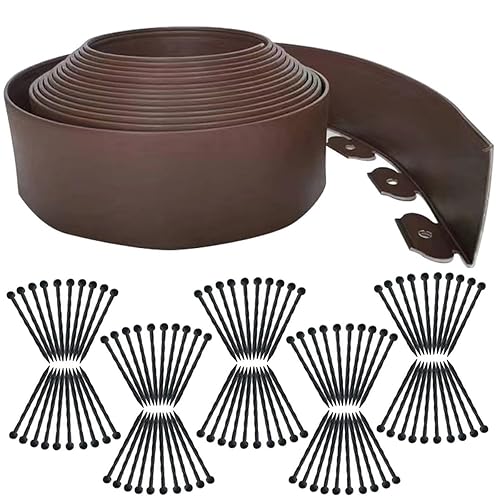 Best budget pickFlexible Garden Edging Borders 66FT,Landscape Edging Brown [Extra TallView on Amazon
- 5
 Best for long runsAmazon Basics Flexible Landscape Edging Coil for Garden Border, FlowerView on Amazon
- 6
 Best for lawn-to-bed transitionsMASTER MARK Terrace Board, Landscape Coiled Edging, 5 in. x 40 ft. with 10 Stakes (Brown)View on Amazon
Our Top Picks
| Product | Best for | Key feature |
|---|---|---|
| L No-Dig Rubber Landscape Edging with Hardware | Straight runs and general use | Included hardware, 3.125 in. height |
| 4′ Rubber Cobblestone Flexible No Dig Edging (12 Edgers) | Curved beds | Flexible sections with anchoring spikes |
| Smart-Loc Rubber 4-Foot Scalloped Edging (12) | Decorative borders | Scalloped top profile, interlocking joints |
| Flexible Garden Edging Borders 66FT | Budget projects and large areas | 66 ft total length with 100 stakes |
| Amazon Basics Flexible Landscape Edging Coil | Long runs | 40 ft coil with 10 stakes |
| MASTER MARK Terrace Board Coiled Edging | Lawn-to-bed transitions | 5 in. height, 40 ft coil with 10 stakes |
L No-Dig Rubber Landscape Edging with Hardware, 3.125″ x 8′, Brown
L No-Dig Rubber Landscape Edging with Hardware, 3.125" x 8', Brown
Best for: Straight runs and general lawn-to-bed separation
This is a good fit for homeowners who want a low, understated border that is easy to set without digging a deep trench. Its shorter profile suits flower beds and mulch lines where a tall wall would look out of place.
Key specs
- Height: 3.125 inches
- Length: 8 feet per piece
- Color: Brown
- Includes hardware for installation
Pros
- Low profile keeps mower deck clearance simple
- Included hardware means no separate stake purchase
- Brown tone blends with mulch and bark
Cons
- Shorter height offers less barrier against deep-rooted grass
- Eight-foot pieces mean more joints on long runs
Bottom line: A sensible first pick for straight borders and mulch beds where a low, clean edge is the goal.
4′ Rubber Cobblestone Flexible No Dig Landscape Mulch Border Edging with Anchoring Spikes
4' Rubber Cobblestone Flexible No Dig Landscape Mulch Border Edging with Anchoring Spikes for Lawns, Gardens, and Flower Beds (12 Edgers, Brown)
Best for: Curved beds and irregular garden shapes
Buyers who plan wavy or circular beds often choose a flexible rubber product that can be bent by hand. The cobblestone profile adds a bit of texture without looking heavy.
Key specs
- Section length: 4 feet each, 12 pieces in the set
- Color: Brown
- No-dig installation with anchoring spikes
Pros
- Bends easily around curves
- Anchoring spikes hold sections in place without trenching
- Textured look suits natural landscapes
Cons
- Sections can shift in soft soil if not spiked well
- Four-foot pieces require careful alignment on long lines
Bottom line: Best for homeowners laying out curved beds who want a flexible, no-dig border.
Smart-Loc Rubber 4-Foot Scalloped Landscape Edging Border (12, Brown)
Smart-Loc Rubber 4-Foot Scalloped Landscape Edging Border (12, Brown)
Best for: Decorative borders and visible garden edges
This type of scalloped edge suits front-yard beds and entry walks where the border is part of the design. The interlocking joints are meant to keep the line visually continuous.
Key specs
- Section length: 4 feet each, 12 pieces
- Color: Brown
- Scalloped top profile
Pros
- Scalloped profile adds visual interest
- Interlocking design helps keep joints aligned
- Consistent brown finish for a tidy look
Cons
- Decorative profile collects more debris in its grooves
- Less suited to very tight curves than flexible coils
Bottom line: A strong choice when appearance matters as much as function along a visible bed.
Flexible Garden Edging Borders 66FT, Landscape Edging Brown [Extra Tall 4IN High] with 100pcs Stakes
Flexible Garden Edging Borders 66FT,Landscape Edging Brown [Extra Tall 4IN High] with 100pcs Stakes,Garden Border Lawn Edging Mini Plastic Fence-Brown
Best for: Budget projects and large areas needing a lot of length
Owners covering big perimeters or multiple beds often look for the most total footage per purchase. This set stands out for length and stake count.
Key specs
- Total length: 66 feet
- Height: 4 inches
- Color: Brown
- Includes 100 stakes
Pros
- Large total length for extended borders
- Taller 4-inch profile holds back more mulch
- Generous stake count for secure anchoring
Cons
- Thinner material may feel less rigid than heavier products
- Some owners note stakes can bend in compacted soil
Bottom line: A practical pick when you need a lot of edging and want to keep the material budget modest.
Amazon Basics Flexible Landscape Edging Coil for Garden Border, Flower Beds, Lawn and Pathways, 5 inch x 40ft, Brown, 10 Stakes
Amazon Basics Flexible Landscape Edging Coil for Garden Border, Flower Beds, Lawn and Pathways, 5 inch x 40ft, Brown, 10 Stakes
Best for: Long straight or gently curving runs
A 40-foot coil lets you install a long border with fewer joints than shorter sections require. This suits perimeter lines along a lawn or pathway.
Key specs
- Dimensions: 5 inches tall, 40 feet long
- Color: Brown
- Includes 10 stakes
Pros
- Long coil means fewer joints
- 5-inch height offers a solid barrier
- Flexible enough for gentle curves
Cons
- Ten stakes may be light for a long run; buying extra is common
- Coil memory can make it want to spring back when unrolled
Bottom line: A good match for homeowners edging long lawn perimeters with minimal joints.
MASTER MARK Terrace Board, Landscape Coiled Edging, 5 in. x 40 ft. with 10 Stakes (Brown)
MASTER MARK Terrace Board, Landscape Coiled Edging, Grass Barrier, Bender Board, Flower Bed, Vegetable Garden Borders 5 in. x 40 ft. with 10 Stakes (Brown)
Best for: Lawn-to-bed transitions where the grass needs a firm barrier
Coiled terrace-style boards are often chosen where a stronger wall is needed to stop grass roots from creeping into planting areas. The 5-inch height gives more depth for that job.
Key specs
- Dimensions: 5 inches tall, 40 feet long
- Color: Brown
- Includes 10 stakes
Pros
- Taller profile helps block grass runners
- Long coil reduces seams
- Brown finish is consistent across the length
Cons
- Stiffer than thinner coils, so tight curves take more effort
- Stake count is modest for the full 40 feet
Bottom line: A solid pick when stopping grass creep matters more than flexibility.
Buying Guide
Height and barrier depth
Height determines how well the border stops grass rhizomes and mulch spill. Lower profiles around 3 inches look clean but may let runners cross; 4 to 5 inches is a common target for lawn-to-bed separation. Check how deep the product sits below grade once installed, because only part of the height is visible.
Good picks for this: MASTER MARK Terrace Board Coiled Edging, Flexible Garden Edging Borders 66FT
Length per pack and joint count
Measure your perimeter first, then divide by the section length. Eight-foot and four-foot pieces create more seams than a 40-foot coil, and each joint is a place where alignment can drift. Long coils reduce joints but need more care when unrolling.
Good picks for this: Amazon Basics Flexible Landscape Edging Coil, L No-Dig Rubber Landscape Edging
Flexibility and curve radius
If your bed has tight curves, choose a product that bends by hand without kinking. Stiffer terrace boards hold straight lines well but can crack if forced into a sharp arc. Test a short piece in cool weather first, since rubber stiffens when cold.
Good picks for this: 4′ Rubber Cobblestone Flexible No Dig Edging, Amazon Basics Flexible Landscape Edging Coil
Anchoring and stake count
Stakes or spikes keep the border from heaving or shifting. Plan for a stake roughly every 12 to 18 inches on straight runs and closer on curves, which may mean more stakes than the pack includes. Soil type matters: loose or sandy soil often needs more anchoring than compacted clay.
Good picks for this: Flexible Garden Edging Borders 66FT, 4′ Rubber Cobblestone Flexible No Dig Edging
Appearance and profile style
Flat or lightly textured profiles look more natural near lawns, while scalloped or cobblestone tops suit decorative beds. Consider how the edge will look when mulch is added, since decorative grooves can catch debris over time.
Good picks for this: Smart-Loc Rubber 4-Foot Scalloped Landscape Edging Border, 4′ Rubber Cobblestone Flexible No Dig Edging
Installation method and soil preparation
No-dig products reduce labor but still benefit from a shallow trench so the top edge sits level with the grass. Clear grass and roots along the line, and check that the border sits at a consistent height before staking. Many installation problems come from uneven setting rather than the product itself.
Good picks for this: L No-Dig Rubber Landscape Edging with Hardware, Amazon Basics Flexible Landscape Edging Coil
Long-term care and color retention
Brown rubber can fade under strong sun and collect dirt, so occasional rinsing helps it look fresh. Keep mulch and soil from piling against the top edge, and check stakes each season for heaving after freeze-thaw cycles. Owners in hot climates often mention that sun exposure affects color more than the product’s material alone.
Good picks for this: MASTER MARK Terrace Board Coiled Edging, Smart-Loc Rubber 4-Foot Scalloped Landscape Edging Border
FAQ
Is brown rubber landscape edging easy to install by yourself?
Yes, for most homeowners. Flexible rubber is light enough to carry and position alone, and no-dig options need only a shallow trench and stakes. Longer coils are easier with a second person to keep the line straight.
How deep should I set rubber edging?
Most manufacturers recommend setting the product so the top sits level with or slightly above the lawn, with the bottom anchored by stakes. Check the specific instructions on your product, since depth varies by design.
Will rubber edging stop grass from spreading into beds?
Taller, deeper profiles block grass runners more effectively than thin, low edges. Grass that roots deeply or spreads by rhizomes may still find gaps, so a deeper set and tight joints help.
How do I keep brown rubber edging from fading?
Rinse it periodically to remove dirt and keep mulch from covering the surface. UV exposure fades color over time in most rubber products, so expect some change in tone in strong sun.
Can rubber edging be used on curves?
Flexible sections and coils handle gentle to moderate curves. Very tight radii may cause kinking or cracking, so choose a more flexible product or cut the border into shorter, carefully shaped pieces.
How many stakes do I need per foot?
A common guideline is one stake every 12 to 18 inches on straight runs, with more on curves and in loose soil. Pack counts often fall short of that spacing on long runs, so plan to buy extra.
Does brown rubber edging work for mulch beds?
Yes. A raised rubber border keeps bark, pine straw or stone mulch inside the bed and separates it from the lawn. Taller profiles hold back more material when beds are topped up.
Conclusion
For most yards, the L No-Dig Rubber Landscape Edging with Hardware is a sensible starting point for straight, low-profile lines. Choose the 4′ Rubber Cobblestone Flexible No Dig Edging for curved beds, the Smart-Loc Rubber Scalloped Edging for decorative borders, and the Flexible Garden Edging Borders 66FT when total length is the priority. The Amazon Basics Flexible Landscape Edging Coil suits long perimeters with fewer joints, while the MASTER MARK Terrace Board Coiled Edging is the better match when a firmer barrier against grass creep is needed. Measure your run, check your bed shape and plan stake spacing before you order.
Sources
- University extension guidance on landscape bed design, mulch depth and edging practices (extension.org)
- Federal guidance on soil conditions and landscape planting that affects anchoring and drainage (usda.gov)
- Information on recycled rubber materials and environmental considerations for landscape products (epa.gov)
Related reading
- Ecoborder 4 Ft Brown Rubber Landscape Edging: Install Clean Lines in 6 Steps
- Groundsmart 4 Roman Brick Rubber Landscape Edging: Install Steps for Clean Lines
- Ecoborder 4 Ft Black Rubber Landscape Edging: Install Clean Lines in Steps
- EcoBorder Rubber Landscape Edging Review: Is It Worth It?
- Brown Metal Landscape Edging: Install It Straight in 7 Steps
About Caleb Morgan
Caleb Morgan is part of our editorial team and reviews and edits our lawn edging & trimming guides, checking product details against manufacturer specifications and owner feedback.